

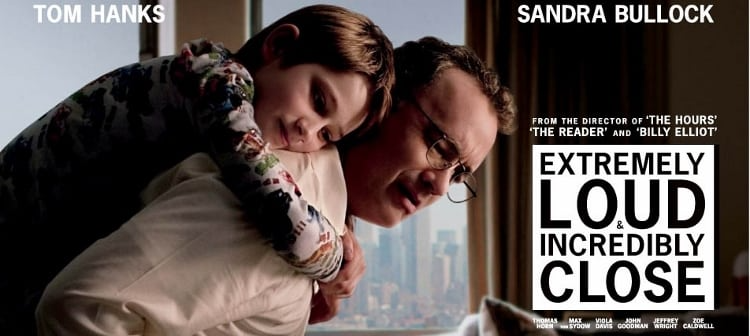
Loud, incredibly manipulative, and strictly for people who love public meltdowns.
Stephen Daldry directs Extremely Loud and Incredibly Close, an adaptation of Jonathan Safran Foer’s 2005 novel about a precocious nine-year-old boy coping with the loss of his father in the September 11 attacks. When young Oskar Schell discovers an enigmatic key inside a vase in his late father’s closet, he embarks on an exhaustive quest across New York City’s five boroughs to locate the matching lock and uncover one final message.
Featuring newcomer Thomas Horn alongside Oscar winners Tom Hanks and Sandra Bullock, the drama pairs its heavy real-world tragedy with a sprawling ensemble of eccentric city residents. The film aims to deliver an emotionally resonant journey of grief, connection, and healing, weaving flashbacks of father-son bonding with a frantic urban scavenger hunt.
Review by Ben Dover
Look, I fired up the streaming box hoping for a decent evening, and instead I got subjected to two hours of a screeching kid terrorizing the five boroughs of New York with a tambourine. If you ever wondered what it feels like to be trapped in an elevator with a spoiled child banging pots and pans together while demanding you validate his feelings, this movie is your golden ticket. I am sixty years old, and back in my day, if a kid screamed in a stranger’s face and carried around a noisemaker on public transit, someone took away his dessert. Here, everyone just cries and hugs him.
The kid, played by Thomas Horn, is supposedly on the autism spectrum, but the movie just writes him like an obnoxious miniature drill sergeant. Tom Hanks plays the saintly father who died in the World Trade Center, and because it is Tom Hanks, he is naturally the most wonderful man who ever walked the earth. He spends his flashbacks inventing elaborate scavenger hunts so his weird son will talk to human beings. Sandra Bullock plays the weeping mother who stays in the background until the third act, when the script suddenly remembers she has an Oscar and needs a scene where she reveals she was tracking the kid the entire time. Max von Sydow shows up as an old mute tenant who communicates strictly through a notepad, and frankly, I envied the guy for not having to speak any of these lines.
As for the technical side, the movie wants you to weep every ten minutes and will not take no for an answer. Alexandre Desplat wrote the musical score, and while he is usually top notch, here the violins are so aggressively manipulative you can practically hear the director behind the camera shouting at you to pull out a tissue. The special effects are mostly slow-motion visual flourishes, fantasy sequences of falling people, and dizzying camera zooms that made me feel like my blood pressure medication had worn off early.
This whole picture is a giant exercise in shameless emotional manipulation. It takes the worst tragedy in modern American history and uses it as decorative wrapping paper for a kid’s treasure hunt across Manhattan. If you want a genuine, heartfelt look at human grief, go talk to your neighbors. If you want a headache and a deep irritation with child actors, stream this right now.
Rating:
2 out of 5 Stars
Complete Synopsis and Plot Breakdown
Nine-year-old Oskar Schell is an exceptionally intelligent boy living in New York City with his loving parents, Thomas and Linda. Thomas constantly challenges Oskar with puzzles and reconnaissance expeditions to help him overcome his fears and social anxieties. On September 11, 2001, Thomas is attending a meeting at the World Trade Center and dies during the terrorist attacks. Before the towers collapse, Thomas leaves six messages on the home answering machine. Oskar listens to them, hides the machine in his closet to keep his grieving mother from hearing the final agonizing call, and replaces it with a duplicate.
A year later, still traumatized and estranged from his depressed mother, Oskar enters his father’s closet and accidentally breaks a blue vase. Inside, he discovers an envelope with the word “Black” written on it, containing a mysterious key. Convinced his father left behind one final puzzle, Oskar determines to find the matching lock. He looks up every person in New York City with the last name Black, finding 472 individuals across 216 addresses, and calculates a meticulous plan to visit each one.
Oskar begins his weekend journeys across the city. His first visit is to Abby Black, a woman undergoing a bitter divorce, who tells him she knows nothing about the key. As Oskar continues his fruitless search, he meets an elderly mute man renting a room from his grandmother across the street. The “Renter” communicates using a notepad and words tattooed on his palms. The old man agrees to accompany Oskar on his citywide treks, helping the boy confront his paralyzing fears of public transit, bridges, and loud noises. Oskar eventually confides in the old man about the hidden answering machine and plays the final message, which reveals that Oskar was in the room when his father called for the last time but was too terrified to pick up the phone.
The Renter soon packs his bags and leaves, overwhelmed by the emotional burden, though Oskar realizes the man is actually his estranged grandfather who fled after the Dresden bombings. Oskar subsequently discovers a telephone number on the back of a photograph from Abby Black’s apartment. He returns to Abby, who admits that the key belonged to her ex-husband, William Black. Oskar meets William and learns the truth: William’s late father had hidden the key inside the vase before William unknowingly sold it to Thomas Schell at an estate sale. The key has no connection to Oskar’s father at all.
Devastated that his mission was meaningless, Oskar destroys his scrapbook and breaks down. His mother enters and reveals that she found out about his search early on; she had visited all the people on his list beforehand to explain his condition and prepare them for his visits. Reconciled with his mother, Oskar makes peace with his grief, creates a revised scrapbook celebrating his father’s memory, and writes letters of gratitude to all the strangers who showed him kindness throughout his journey.
Famous Quotes
- “If things were easy to find, they wouldn’t be worth finding.”
- “There are so many different ways to die, and I just need to know which was his.”
- “I used to have a lot of things to say, but now I don’t.”
- “You can’t live in fear. You have to keep going.”
- “I’m going to do what he would have done. I’m going to look.”
Trivia and Interesting Facts
- Thomas Horn had never acted professionally before being cast in the lead role; the producers discovered him after he won on Jeopardy! Kids Week in 2010.
- Max von Sydow earned an Academy Award nomination for Best Supporting Actor for his role as The Renter without speaking a single line of dialogue in the entire film.
- The film marked the final screen acting collaboration between veteran actors Max von Sydow and Zoe Caldwell.
- The production obtained permission to film throughout all five boroughs of New York City, staging encounters in actual neighborhoods across Manhattan, Brooklyn, Queens, the Bronx, and Staten Island.
- Despite receiving an Academy Award nomination for Best Picture, the movie divided critics sharply and holds one of the lowest critical approval scores among modern Best Picture nominees.
Photos


Trailer