

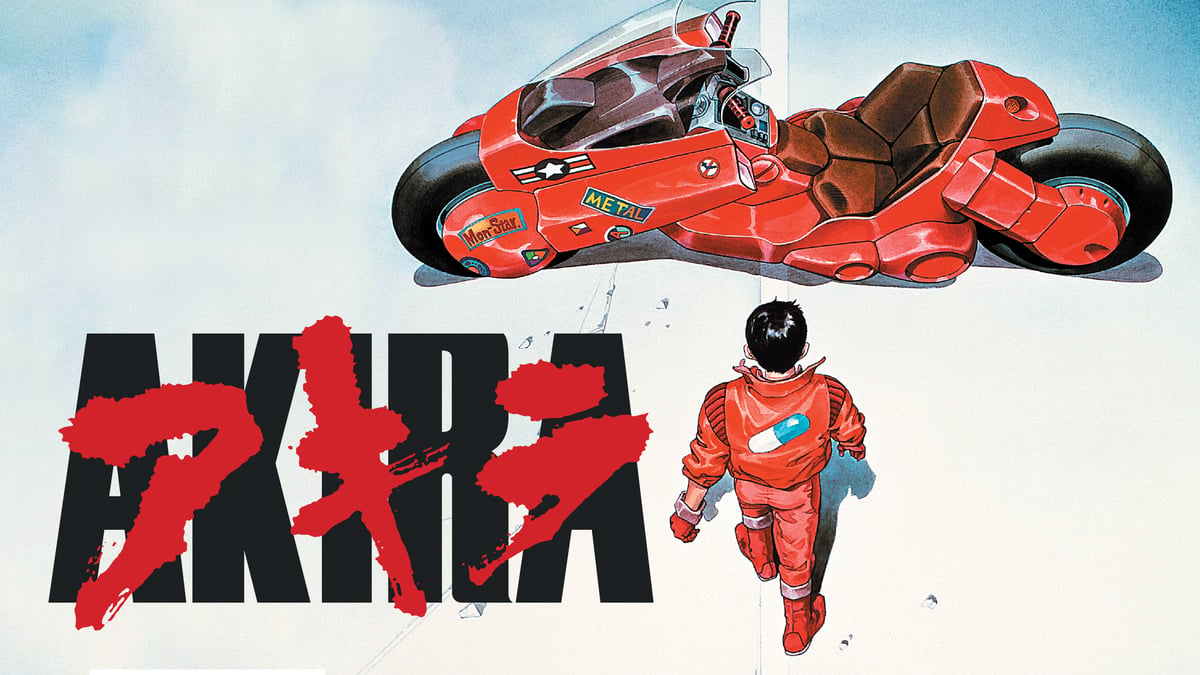
Preview
Set in the futuristic year of 2019, thirty-one years after Tokyo was completely wiped off the map by a nuclear explosion, Akira plunges audiences into the corrupt, neon-drenched metropolis of Neo-Tokyo. The city is on the brink of total collapse, torn apart by anti-government riots, religious fanatics, corrupt politicians, and vicious teenage biker gangs who spend their nights beating each other with iron pipes.
When a reckless biker kid named Tetsuo crashes his motorcycle into a strange child who looks like a seventy-year-old shriveled prune, he is taken by the military and accidentally unlocks terrifying telekinetic powers. His best friend and gang leader, Kaneda, must navigate the military state, underground rebel fighters, and secret government experiments to stop Tetsuo before he unleashes the legendary entity known as Akira and blows up the city all over again.
Akira is a classic and acted as a gateway film, proving to international audiences that anime was serious art, not just children’s programming. The film crams a massive 2,000-page, six-volume manga epic into a tight two-hour runtime. The movie was produced while the comic was still ongoing, forcing director Katsuhiro Otomo to invent a compressed, abstract second half and a cryptic ending other than that it is a perfect film.
4K Release returning to theaters on Sept 4th, 2026
Review by Ben Dover
Ben Dover watches Japanese cartoons so you don’t have to – ed.
Listen, I am sixty years old. I grew up on John Wayne, Clint Eastwood, and movies where you could actually tell who the good guys were because they wore the white hats. My buddy tells me I need to get with the times and stream some legendary Japanese animation. He swore it was a masterpiece. So I sat down in my recliner with an iced tea and an edible, and hit play on this 1988 cartoon called Akira, and I am pretty sure I lost half my remaining brain cells by minute forty-five. It is loud, it is completely nuts, and every teenager in it needs a swift kick in the rear end.
The main kid, Kaneda, runs around in a clown-shoe-red motorcycle suit acting like he owns the place. He leads a bunch of delinquent brats called the Capsules. If kids in my neighborhood behaved like this, their fathers would have straightened them out in five minutes flat. Instead, these punk kids race around on futuristic mopeds smashing rival gangs with pipes. Then his buddy Tetsuo gets a massive inferiority complex, gets kidnapped by the army, and suddenly develops brain powers that let him crush tanks with his mind. Why does every kid today think they are special? This brat gets superpowers and his first reaction is to go throw a tantrum at the Olympic stadium.
Now, do not get me wrong, I wanted to hate this whole thing, but I have to give credit where credit is due. The sheer amount of work that went into drawing this movie is mind-boggling. There is no computer-generated garbage here. Every single building, explosion, broken piece of glass, and tail-light streak was drawn by hand. When a building collapses in this movie, you actually feel it in your gut. It looks better than ninety-nine percent of the bloated, soulless junk Hollywood puts in theaters today.
That being said, the last thirty minutes make absolutely zero sense. Tetsuo turns into a giant, pulsating blob of flesh and baby limbs that swallows his own girlfriend, and everyone starts screaming about the secrets of the universe like a bunch of hippies at a drum circle. I do not care about the cosmic birth of a new dimension; I just wanted to see the army blow up the monster with a giant space laser. It is gross, it gives you a headache, and yet you cannot take your eyes off the screen.
It is a bloody, chaotic, gorgeous mess of a movie that proves cartoons are definitely not just for Saturday mornings. If you can tolerate two hours of angsty Japanese teenagers screaming each other’s names at the top of their lungs while the city crumbles around them, you will have a good time.
The Cast
- Mitsuo Iwata / Cam Clarke / Johnny Yong Bosch as Shotaro Kaneda: The brash, cocky leader of the Capsule biker gang. Depending on which English dub you listen to, he either sounds like Leonardo the Ninja Turtle or a standard angry anime kid.
- Nozomu Sasaki / Jan Rabson / Joshua Seth as Tetsuo Shima: Kaneda’s insecure buddy who develops god-like psychic powers and decides to take his teenage angst out on the entire city.
- Mami Koyama / Lara Cody / Wendee Lee as Kei: An underground resistance fighter who spends half the film trying to overthrow the corrupt government and the other half trying to keep Kaneda from hitting on her.
- Taro Ishida / Tony Jay / Jamieson Price as Colonel Shikishima: The hard-nosed military boss trying to maintain order. The only guy in the entire movie with a real job, a decent haircut, and a sense of duty.
- Mizuho Suzuki / Lewis Arquette / Simon Prescott as Doctor Onishi: The scientist in a lab coat whose reckless experiments with psychic energy cause the entire catastrophe in the first place.
Special Effects and Music
Special Effects
For a movie drawn completely by hand in the late 1980s, the animation is nothing short of incredible. The cityscapes are dense, the lighting effects from the motorcycles are iconic, and the body-horror mutation at the climax is pure nightmare fuel. It puts modern computer effects to absolute shame.
Music
The soundtrack by the musical collective Geinoh Yamashirogumi is wild. It uses traditional Indonesian gamelan percussion mixed with eerie human breathing, chanting, and heavy synthesizer organs. It does not sound like regular movie music at all; it sounds like a bunch of monks banging on pots and pans while hyperventilating into a microphone, but somehow it fits the madness perfectly.
Ben Dover’s Rating
4 out of 5 Stars(Lost a full star because the ending belongs in an asylum and my ears are still ringing from all the screaming.)
Complete Synopsis and Plot Breakdown
In 1988, an enormous explosion annihilates Tokyo, sparking World War III. Decades later in 2019, Neo-Tokyo is a corrupt, dystopian city built on an artificial island in Tokyo Bay, plagued by civil unrest and gang violence.
Shotaro Kaneda leads a teenage biker gang known as the Capsules. During a violent street battle with a rival gang called the Clowns, Kaneda’s close friend Tetsuo Shima crashes his motorcycle into Takashi, an escaped child with psychic abilities and the wrinkled appearance of an elderly man. The military, led by Colonel Shikishima and accompanied by the telepathic child Kiyoko, arrives and takes both Takashi and Tetsuo into custody.
At a secret military laboratory, Doctor Onishi discovers that Tetsuo possesses extraordinary psychic potential comparable to “Akira,” a powerful esper child whose uncontrolled power caused the destruction of Tokyo in 1988. Meanwhile, Kaneda is arrested and meets Kei, an underground resistance fighter. Kaneda helps her escape, eventually joining her rebel group to infiltrate the military hospital and find Tetsuo.
Tetsuo’s latent powers manifest rapidly, accompanied by severe migraines and hallucinations. He easily escapes containment, killing hospital staff and stealing Kaneda’s high-tech red motorcycle. Kaneda and the Clowns confront him, but Tetsuo is overcome by psychic pain and retrieved by Shikishima. Shikishima warns the city’s corrupt governing council of the impending danger, but the politicians refuse to listen and cut his funding, prompting Shikishima to stage a military coup to control the crisis.
Tetsuo breaks out again, slaughtering soldiers and scientists alike. He learns that Akira’s physical remains are sealed in cryogenic storage deep beneath the construction site of the new Olympic Stadium. Tetsuo flies across the city, brutally destroying everything in his path, including military tanks and attack helicopters. Shikishima attempts to vaporize Tetsuo using the orbital laser satellite SOL, severing Tetsuo’s arm, but Tetsuo flies into space and damages the satellite.
At the Olympic Stadium, Tetsuo unearths the underground vault, only to find that Akira’s body was dissected and preserved in scientific sample jars. Kaneda arrives to duel Tetsuo with a laser rifle. Tetsuo’s powers spin completely out of control, causing his severed arm to regenerate into a grotesque, mutating mass of biological tissue that expands into a monstrous flesh blob. The mass crushes Doctor Onishi and engulfs Tetsuo’s girlfriend, Kaori, as well as Kaneda.
The remaining psychic children—Takashi, Kiyoko, and Masaru—awaken the preserved remnants of Akira to counter Tetsuo. Akira manifests an enormous expanding sphere of energy to absorb Tetsuo. The children dive into the vortex to rescue Kaneda, transporting him safely away while Akira and Tetsuo’s energy collapses into a new universe. Neo-Tokyo is left partially flooded and ruined, Shikishima watches the aftermath, and Kaneda rides off into the dawn with Kei and his surviving gang member, hearing Tetsuo’s final telepathic message echoing across existence: “I am Tetsuo.”
5 Famous Quotes
- “That’s Mr. Kaneda to you, punk!” — Kaneda
- “Kaneda, you’ve always been a pain in the ass. You’ve been telling me what to do since we were kids. Always treating me like a kid.” — Tetsuo
- “KANEDA!” / “TETSUO!” — Tetsuo and Kaneda (screamed back and forth repeatedly)
- “The future is not a straight line. There are many different pathways.” — Kiyoko
- “I am Tetsuo.” — Tetsuo
5 Interesting Notes & Trivia
- Massive Hand-Drawn Frame Count: The film features over 160,000 individual animation cels, which was virtually unheard of for an animated production in 1988.
- Pre-Scored Dialogue: Unlike standard Japanese anime at the time, which animated the mouths first and recorded the voices later, Akira used pre-scored voice acting so the animators could sync the lip flaps accurately to the spoken Japanese words.
- Huge Color Palette: The production used 327 distinct colors, including 50 custom colors that had to be created specifically for the film’s neon night scenes.
- The Iconic Slide: Kaneda’s sideways motorcycle slide became one of the most referenced animation shots in history, parodied and paid homage to in dozens of shows including Batman: The Animated Series, Adventure Time, and Star Wars: The Clone Wars.
- The 2020 Tokyo Olympics Prediction: The film famously predicted that Tokyo would host the 2020 Olympic Games decades before it actually happened, complete with a billboard counting down the days.
Just for fun here is how Jordan Peele showcased the “Akira Slide”

Photos


