

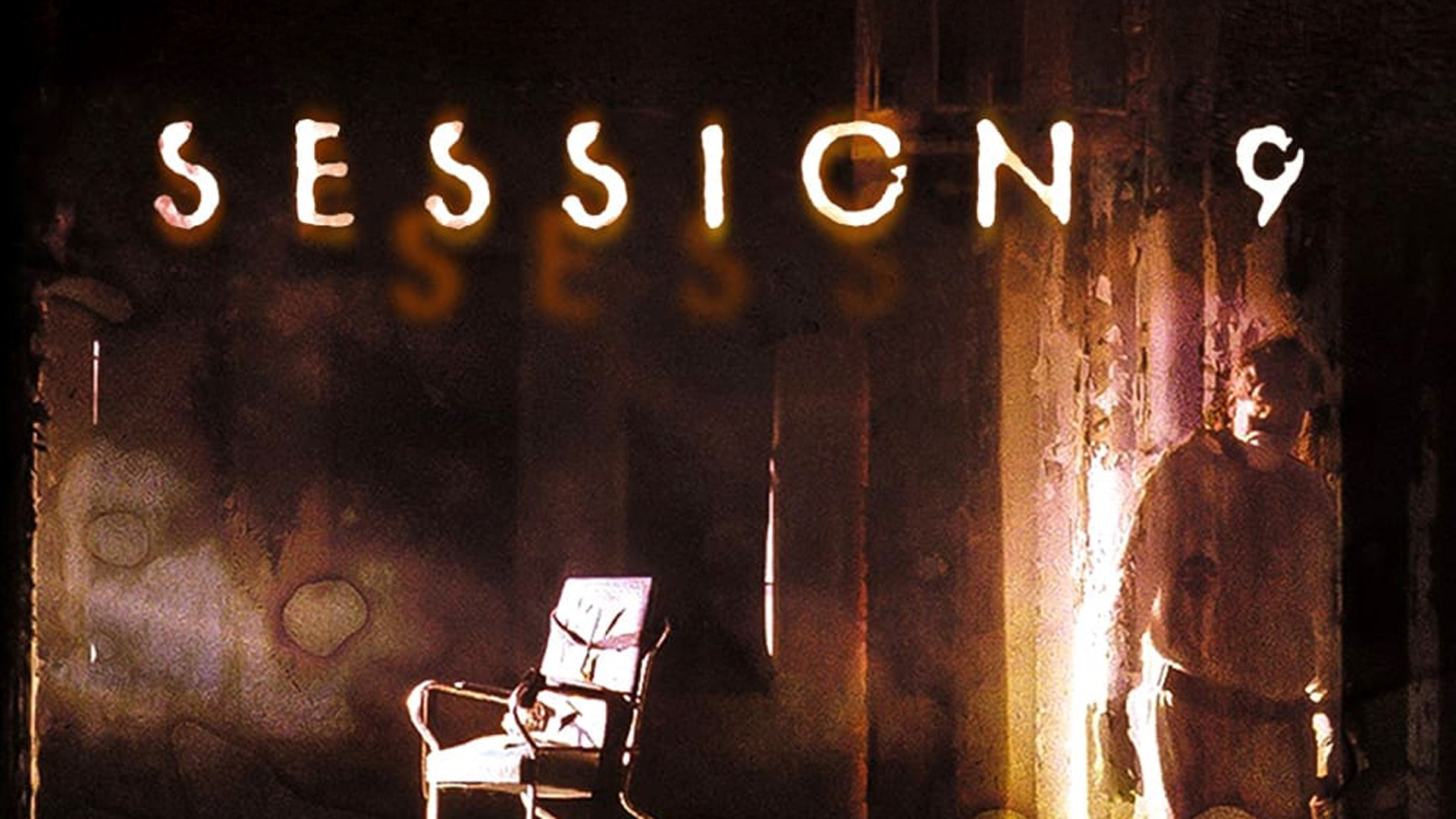
Preview
If your idea of a thrilling Friday night involves watching paint peel off walls while five sweaty handymen whine about their feelings, then clear your schedule. Brad Anderson’s 2001 psychological snooze-fest Session 9 has shambled its way onto home streaming platforms. It dares to ask the age-old question: what happens when you stick a crew of asbestos-removal workers inside an abandoned mental asylum and forget to write an actual plot for the first seventy minutes?
Set inside the sprawling, mold-infested ruins of the real Danvers State Mental Hospital in Massachusetts, the film attempts to substitute crumbling masonry and rusty gurneys for genuine human suspense. Instead of monsters or a proper slasher, you get David Caruso glaring through a pair of cheap sunglasses and a guy obsessively playing cassette tapes while ignoring his day job. Grab an extra cup of black coffee before pressing play, because you are going to need it.
Review by Ben Dover
I am sixty years old, my lower back throbs whenever the weather changes, and I simply do not have the time or the patience to sit through another slow-burn indie movie where literally nothing burns. People on the internet talk about Session 9 like it is a lost crown jewel of atmospheric horror. What a load of absolute garbage. This whole thing feels less like a horror movie and more like a mandatory six-hour OSHA workplace safety seminar filmed on a bargain-bin camcorder by someone who failed art school.
The story kicks off with five miserable guys in jumpsuits who get hired to scrape poisonous crud out of an old lunatic asylum in five days. That is the whole premise. Right away, you can tell the director thought the building would do all his homework for him. Sure, the asylum looks dirty and decrepit, but after twenty minutes of looking at rusted pipes, empty hallways, and water-damaged plaster, I got the message. I don’t need eighty more minutes of guys shuffling down corridors with flashlights looking like they just lost their car keys.
Then we have the acting, which swings wildly between dead-eyed muttering and pure soap opera melodrama. David Caruso treats every single line delivery as if he is trying to win an award for the grumpiest guy in New England. There is one scene where he drops an F-bomb with his sunglasses off, and it is so stiff and cartoonish I nearly choked on my dentures laughing at him. Meanwhile, the lead guy, Gordon, looks like he swallowed a lemon in every single scene. The characters are completely unlikable losers. Why on earth would I care if a bunch of whiny guys who hate each other get picked off in a basement?
Modern audiences love to hype this flick up because it tricks you into thinking it is deep and philosophical. It isn’t deep. It just takes cheap psychological mumbo-jumbo and drags it out until your legs fall asleep. You sit through an hour and a half of guys digging up loose change and listening to crackly therapy tapes just to get hit with a tired twist ending you could see coming from three counties away.
In the end, Session 9 is a colossal waste of ninety minutes that gives you nothing to chew on except dust and regret. If I wanted to watch a bunch of grumpy, underpaid laborers shout at each other inside a crumbling wreck of a building, I would just invite my brother-in-law over to fix my porch. Save your eyesight and go watch something where things actually happen.
Cast & Characters
- David Caruso (Phil): The bitter, chain-smoking ex-partner of the business who is stewing in pure resentment because Gordon stole his girlfriend. Caruso plays Caruso, complete with dramatic squints and tough-guy scowls, but here the jerk attitude actually fits like a glove. He spends ninety percent of his screen time squinting into the middle distance and delivering every line like an angry gym coach.
- Peter Mullan (Gordon Fleming): The weary, sleep-deprived owner of the hazmat crew. Mullan is fantastic at looking like a man whose soul left his body three weeks ago. Between a newborn baby at home and mountain-high debts, he is a walking nervous breakdown. He walks around with an expression that suggests he hasn’t had a solid bowel movement since 1998, mumbling his lines and constantly rubbing his temples.
- Stephen Gevedon (Mike): A law-school dropout who works the job just to kill time. He finds a box of therapy reel-to-reel tapes documenting a patient with multiple personalities and spends half his work shift secretly listening to them instead of scraping pipes.
- Josh Lucas (Hank): The handsome, arrogant loudmouth of the crew who talks trash, gambles too much, and stumbles upon a secret stash of antique silver and valuable coins hidden behind a crematorium wall. He spends his shift sneaking around looking for things to steal and predictably gets what is coming to him early on.
- Brendan Sexton III (Jeff): Gordon’s skittish nephew who has a mortal fear of the dark. Naturally, he gets assigned to work in pitch-black tunnels. The kid spends the whole movie looking like he is about to cry into his sandwich. Since Caruso wont, he wears sunglasses indoors and screams like a frightened toddler the moment a lightbulb flickers.
Special Effects & Music
- Special Effects: What special effects? The entire budget clearly went into renting the asylum and buying cheap paper suits from the hardware store. There is almost zero blood, the makeup looks like leftover greasepaint from a high school play, and the big scares rely on flickering lights and shaky handheld camera tricks that give you a headache. The decaying set does all the heavy lifting.
- Music & Sound: The sound design is downright nasty. Composers Climax Golden Twins provide a low, droning, metallic ambient score that sounds like someone dragging a pipe across concrete in an empty room. Layer that with the scratchy, crackling playback of the reel-to-reel psychiatric tapes, and the audio alone will give you the creeps.
Rating
1 out of 5 Stars – Think your day job is torture? Try watching David Caruso scowl in a paper jumpsuit for an hour and a half.
It had two stars purely out of respect for the construction crew who had to clean up that filthy building after the film crew packed their junk and left, but it loses a full star because Caruso’s dramatic tough-guy scream made me spill my ginger ale.
Complete Synopsis & Plot Breakdown
Gordon Fleming runs a struggling hazmat abatement company in Massachusetts. Desperate for cash to support his wife and infant daughter, Gordon bids on a massive contract to clear hazardous asbestos from the abandoned Danvers State Mental Hospital. To beat out his competitors, he recklessly promises to finish a three-week cleanup in just five days. He gathers his crew: his resentful former partner Phil, law school dropout Mike, the reckless hotshot Hank, and his nervous young nephew Jeff.
As work begins on Monday, Gordon is clearly unraveling from stress and lack of sleep. While exploring the basement, Mike discovers a box of audio recordings containing nine taped psychiatric sessions from 1974. The tapes chronicle Dr. Wooding treating Mary Hobbes, a young woman who was committed after committing a violent murder at her family home. Mary suffers from multiple personalities, including a timid girl named Princess and a protective boy named Billy.
Meanwhile, Hank discovers a hidden cavity behind a basement wall containing antique half-dollars and surgical silverware. He sneaks back into the asylum alone late Monday night to steal the loot, but while stuffing his pockets, he hears a strange noise and is attacked in the dark by an unseen figure.
By Tuesday, Hank is missing. Phil assumes he took the money and skipped town. The pressure mounts, and Gordon’s mental stability deteriorates further. Mike continues listening to Mary’s therapy tapes in secret, completely fascinated by her references to a mysterious, hidden third personality that Dr. Wooding has not yet unlocked.
On Thursday, Hank suddenly wanders back into the building in broad daylight, dazed, shirtless, and completely catatonic with a tiny patch of tape on his eye. Chaos erupts. Jeff panics during a power outage in the pitch-black basement tunnels and is violently stabbed to death with an industrial lobotomy needle. Phil confronts Gordon, realizing something is terribly wrong, but is ambushed and murdered. Mike heads down to the basement to shut off the generator, finds Hank dead on a gurney with a needle through his eye, and is struck down from behind.
The final reel-to-reel recording, Session 9, plays in full. In the recording, Dr. Wooding finally wakes Mary’s dominant, homicidal alter ego, who identifies himself as “Simon.”
A series of grim flashbacks reveals the horrifying truth: Gordon did not just snap at the hospital. On the previous weekend, before the job even started, Gordon accidentally burned his leg with boiling water at home, lost his mind, and murdered his wife, their baby daughter, and the family dog in a blind rage. Driven by complete psychological denial, Gordon showed up to work, hallucinated calls with his dead wife, and proceeded to systematically slaughter his entire crew one by one under the influence of the “Simon” personality.
The film ends with a broken Gordon sitting alone in the asylum, staring blankly as the voice of Simon echoes in his head. When the doctor on the tape asks Simon where he lives, Simon chillingly whispers: “I live in the weak and the wounded, Doc.”
5 Famous Quotes
- “Hey… fuck you!”
- “I live in the weak and the wounded, Doc.”
- “Do you know what happened, Mary? Do you know what you did?”
- “It’s the place. It’s got something to do with the place.”
- “Hello, Gordon.”
Notes & Interesting Facts
- The Asylum Was 100% Real: The movie was shot on location at the actual Danvers State Hospital, an infamous Kirkbride-style asylum built in 1878 that was rumored to be the birthplace of the prefrontal lobotomy and the real-world inspiration for H.P. Lovecraft’s Arkham Sanitarium.
- Real Hazards on Set: The crew had to wear actual protective equipment during parts of the shoot because the abandoned facility was genuinely contaminated with airborne asbestos and dangerous black mold.
- Pioneering Digital Video: It was one of the earliest feature horror films shot entirely on the Sony HDW-F900 24p high-definition digital camera, the exact same camera George Lucas used around the same time to film Star Wars: Episode II – Attack of the Clones.
- Demolished for Condos: In 2006, just five years after the movie came out, most of the historic Danvers complex was torn down by developers to build an apartment complex, though a mysterious massive fire burned down much of the remaining active construction site during the process.
- No Special Effects Budget: The entire production budget was under two million dollars, meaning director Brad Anderson had to rely almost entirely on available sunlight, practical props, and genuine building decay rather than movie sets.
- Box Office Flop: Despite gathering a niche cult following on home video years later, the film bombed hard during its original theatrical run, pulling in less than 400,000 dollars at the box office.
Photos


Just for fun here is David Caruso telling you exactly how he feels